PRODUCT DESIGN CASE STUDY / PARSEON
Making document transformation legible.
Designing a clearer path from financial paperwork to structured information that a person can inspect.
- My role
- Product & interface design
- Designed for
- People working with financial documents and structured data
- Scope
- Web product · document context, upload, and output review
- Project
- ParseonProduct design study
01 / THE STARTING POSITION
A problem
worth solving.
The context
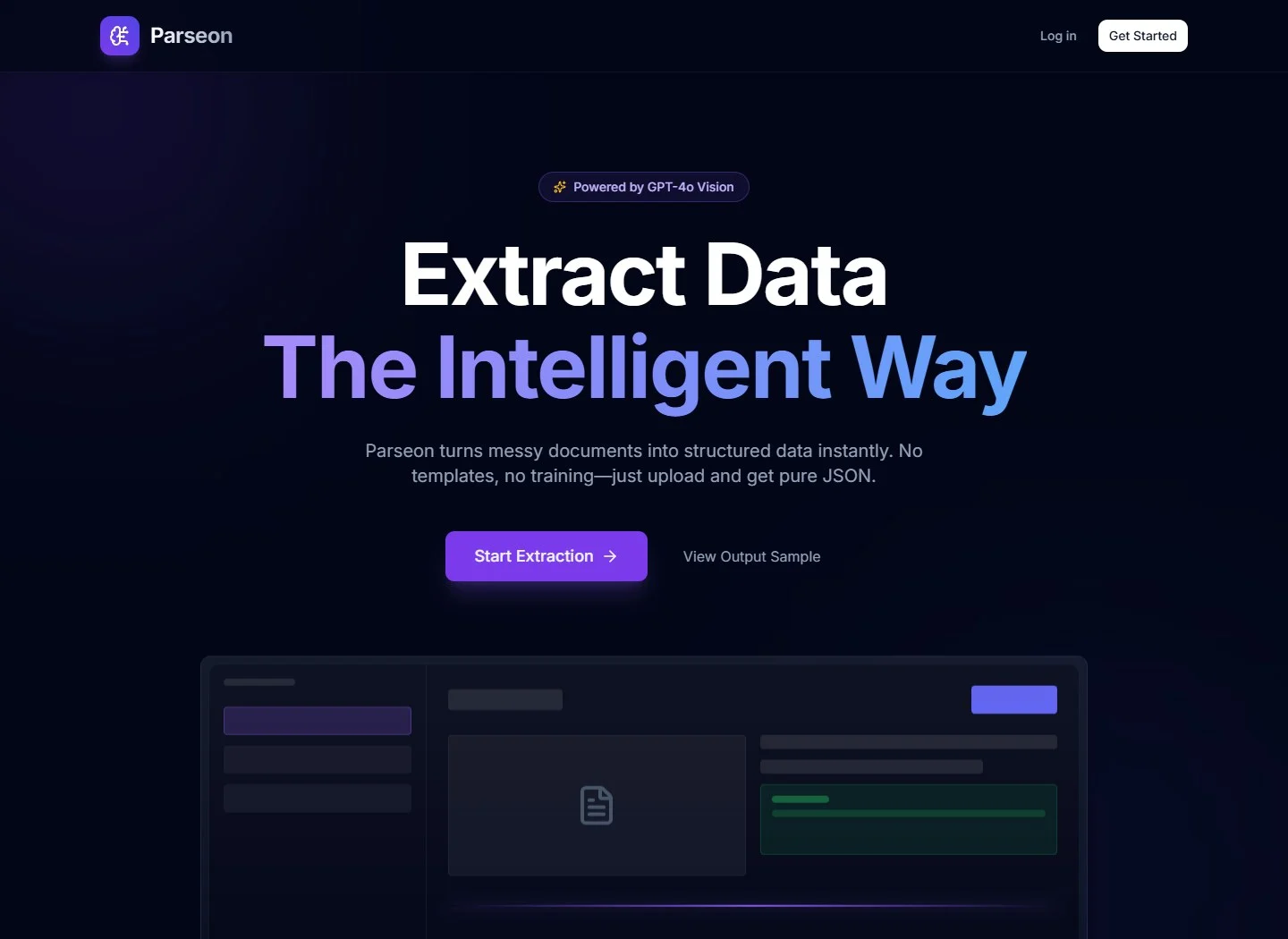
Parseon presents an extraction workflow for documents such as pay stubs, tax returns, and loan applications. Its interface needs to explain both what the product accepts and what the resulting data will look like.
The challenge
The transformation from a document to JSON is mostly invisible. Without clear stages and an understandable output, a person has little context for judging what the product has done.
THE DESIGN GOALMake the input, transformation, and output distinct enough that the workflow is easy to follow and the result is available for review.
02 / FINDING THE DIRECTION
What guided
the design.
Establish context first.
Document type gives the upload a purpose and frames the expected information.
Explain the transition.
The person should be able to distinguish providing a file from inspecting its output.
Show the intended result.
A structured example makes the promise of document extraction concrete.
03 / THE EXPERIENCE, STEP BY STEP
A path through
the product.
A flow map of the product experience, from the first action to the next useful step.
- 01Context
Select the document type
Establish what kind of financial paperwork is being provided.
- 02Input
Upload the document
Keep the source file separate from the resulting information.
- 03Process
Move through extraction
Give the transformation a distinct stage in the task.
- 04Review
Inspect structured output
Present the resulting JSON for inspection and reuse.
04 / THE THINKING BEHIND THE INTERFACE
Decisions that
shape the experience.
Document type gives the first step meaning.
Financial paperwork contains different kinds of information, even when the interaction begins with the same upload action.
- The design choice
- Establish document-type context before extraction.
- Why it matters
- This helps explain what the product is about to process and gives the next step a more specific purpose.
- The consideration
- The document categories need to be understandable to the person supplying the file, including when their document does not fit neatly.
Separate the input from the result.
An upload control alone does not explain where the document goes or what happens next.
- The design choice
- Organize the product around recognizable upload and output stages.
- Why it matters
- A staged flow makes the transformation easier to follow and gives the resulting information a clear place in the interface.
- The consideration
- Processing, failure, and retry states need to preserve the person’s understanding of where they are in the task.
Use a structured sample to explain the promise.
“Extract data” is abstract until the person can see what the output contains.
- The design choice
- Present JSON output as part of the product story and review experience.
- Why it matters
- A concrete sample communicates the shape of the result and connects it to the idea of reuse in another workflow.
- The consideration
- A readable format supports inspection, while correctness still requires checking the output against its source document.
05 / WHERE THE DESIGN LANDED
The outcome.
The next move.
The resulting experience
The design establishes a document-to-data journey with distinct context, input, and output stages. The structured sample makes the intended transformation visible before the person commits to a document workflow.
What I take forward
Clarity here comes from making a hidden transformation understandable. The output format is only one part of that; the transitions and document context do just as much explanatory work.
What I would evaluate next
- Observe whether people understand the document categories before uploading.
- Evaluate the clarity of processing, retry, and result-review states.
- Check how easily a person can compare extracted information with its source.