PRODUCT DESIGN CASE STUDY / KALIBER
From match evidence to a next move.
Designing a gameplay review experience around one practical improvement a player can take into the next session.
- My role
- Product & interface design
- Designed for
- Ranked Valorant players reviewing their gameplay
- Scope
- Web product · coaching reports and a weekly practice loop
- Project
- KaliberInteractive demo
01 / THE STARTING POSITION
A problem
worth solving.
The context
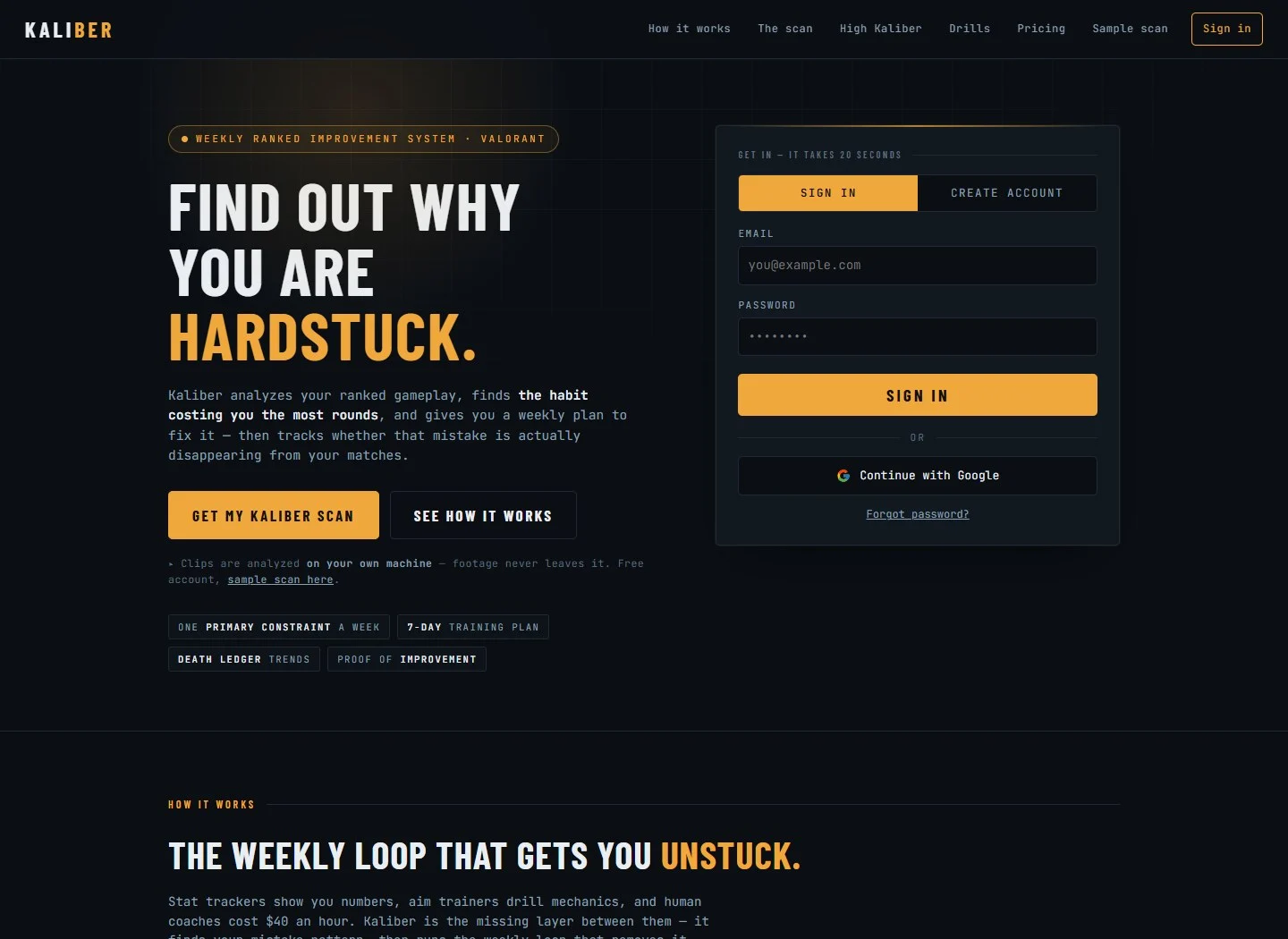
Kaliber connects a gameplay report with drills, a weekly constraint, a seven-day plan, and a death ledger. These surfaces need to support one improvement loop rather than compete for the player’s attention.
The challenge
A report can explain many things that went wrong in a match without making it clear what the player should practice first. More analysis alone does not establish a useful next action.
THE DESIGN GOALConnect evidence, one weekly focus, and repeat practice in a coherent report-to-training journey.
02 / FINDING THE DIRECTION
What guided
the design.
Lead with a usable takeaway.
The player should be able to recognize the pattern they are working on before studying every supporting detail.
Keep advice connected to evidence.
Match context gives a coaching recommendation something concrete to refer to.
Design for the next session.
A training plan and a later review give the report a place in an ongoing routine.
03 / THE EXPERIENCE, STEP BY STEP
A path through
the product.
A flow map of the product experience, from the first action to the next useful step.
- 01Review
Read the match report
Start with a pattern and the match evidence that explains it.
- 02Focus
Choose the weekly constraint
Give the player a specific behavior to pay attention to.
- 03Practice
Follow the seven-day plan
Connect the focus to drills and repeated practice.
- 04Reflect
Return to the death ledger
Keep a record that can inform the next review.
04 / THE THINKING BEHIND THE INTERFACE
Decisions that
shape the experience.
A report with a hierarchy, not a wall of advice.
The product brings together observations, supporting evidence, and recommendations.
- The design choice
- Structure the experience around a recurring gameplay habit, with detail supporting that focus.
- Why it matters
- The hierarchy gives the player a route through the report and connects its parts to a recognizable question: what should I work on?
- The consideration
- A concise takeaway must remain connected to match context so that simplifying the report does not make the advice feel arbitrary.
A weekly constraint as the bridge to action.
A player can understand feedback and still struggle to apply it in a fast-moving match.
- The design choice
- Give the weekly focus a clear role between the report and the seven-day practice plan.
- Why it matters
- The constraint translates a broad improvement theme into a behavior the player can keep in mind during practice.
- The consideration
- A single focus creates clarity, but the player still needs to understand which situations it applies to.
Close the loop after the report.
A one-time analysis ends just as the player starts to practice.
- The design choice
- Connect drills, the training plan, and the death ledger as supporting parts of the same routine.
- Why it matters
- These surfaces make room for repeated practice and a later review instead of treating the report as the end of the experience.
- The consideration
- Tracking should support reflection without becoming a second task that overwhelms the practice itself.
05 / WHERE THE DESIGN LANDED
The outcome.
The next move.
The resulting experience
The interactive sample presents a coherent improvement loop: match evidence leads to a weekly focus, a practice plan, and a place to reflect. The hosted demo makes the report experience available for exploration.
What I take forward
The strongest design connection is between understanding and doing. The report needs enough context to feel grounded, while the practice plan needs enough focus to feel manageable.
What I would evaluate next
- Observe whether players can explain their weekly focus after reviewing a report.
- Check the transitions from supporting evidence to drills and the training plan.
- Evaluate whether the ledger helps players reflect without adding unnecessary effort.
Explore a sample gameplay report. New video uploads and scans are unavailable on the current hosted demo.
Explore Kaliber (opens in a new tab)